

Distributed Systems Design Patterns: Practical Implementation Guide
How to apply system design thumb rules to actual engineering problems

Engineer. Builder. Systems thinker.
I write about software architecture, AI-powered applications, and the journey of building scalable solutions from scratch. Passionate about using technology, automation, and intelligent systems to solve real business problems and create impact at scale.
Introduction: Bridging Theory and Practice
If you have read my previous article, Distributed Systems Design: 12 Rules To Prevent Production Failures, you are on a great track. But when you sit down at your desk Monday morning to design a new feature, I can understand if the theory feels distant and abstract.
It's like the blank whiteboard mocks you. Should you use a queue here? Is this a good place for caching? How do you actually apply "design for failure" to a payment processing system? What does "measure first" really mean when you're under pressure to ship?
This is the gap between theory and practice, and it's where most engineers struggle.
This article bridges that gap. Building on the foundational principles from my System Design Thumb Rules guide, we'll demonstrate how those twelve abstract rules translate into concrete decisions. Through real-world scenarios, systematic workflows, and battle-tested patterns, you'll learn to move from principles to production-ready architectures.
Think of the first article as learning the rules of chess. This article is learning how to actually win games. The rules don't change, but their application in dynamic, complex situations requires practice, pattern recognition, and strategic thinking.
Let's begin with something everyone understands: lunch.
Three Real-World Scenarios: Rules in Action
Scenario 1: The Food Truck Lunch Rush (Horizontal Scaling & Throughput)
The Problem: A food truck serves tacos during the lunch rush. Between 12:00 PM and 1:00 PM, 200 customers queue up for orders. Each taco takes approximately 3 minutes to prepare from order to serving.
The Math: One chef working sequentially can serve 60 minutes ÷ 3 minutes per order = 20 customers per hour. That means 180 angry, hungry customers and one very stressed chef.
Attempt 1: Vertical Scaling (The Wrong Approach)
"Let's hire a super-chef! Someone who can make tacos in 90 seconds instead of 3 minutes!"
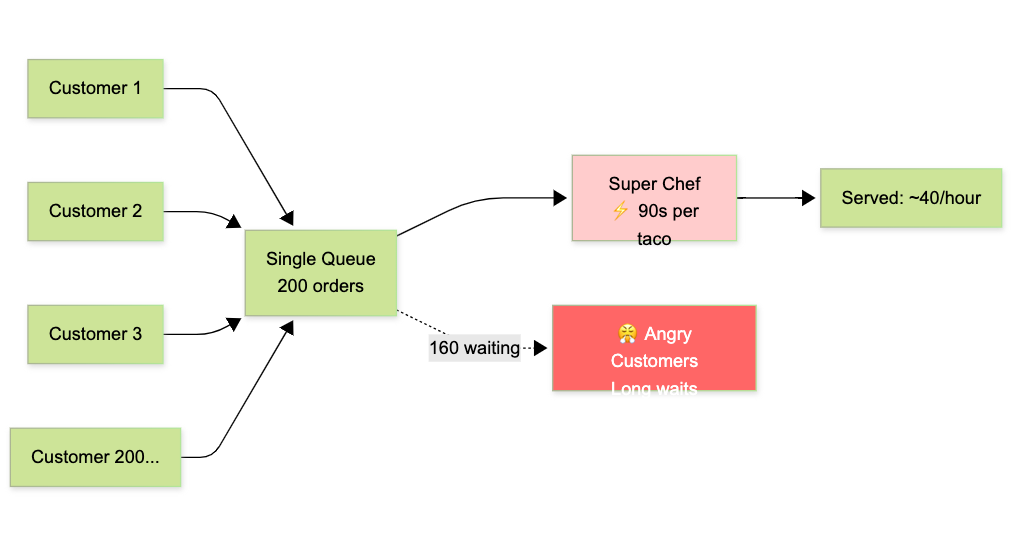
Even with a super-chef who's twice as fast, you only serve 40 customers per hour. The line is still unacceptable. This is vertical scaling—making individual components more powerful. It helps, but it doesn't solve the fundamental throughput problem.
The Issue: You've hit the physical limits of human performance. Even the world's fastest taco chef can only move so fast. This is the ceiling of vertical scaling.
Attempt 2: Horizontal Scaling with Partitioning (The Right Approach)
Instead of one super-chef, hire three normal chefs and specialize them:
Chef 1: Chicken tacos (60% of orders)
Chef 2: Beef tacos (30% of orders)
Chef 3: Vegetarian tacos (10% of orders)
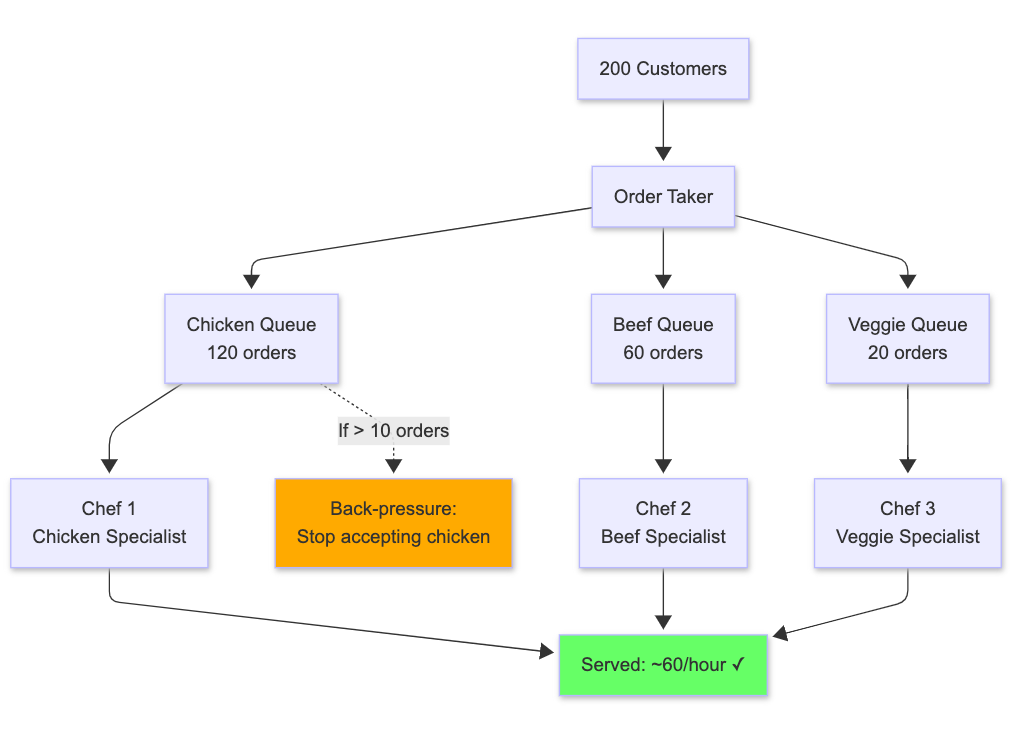
The Results:
Chef 1 (chicken): 20 tacos/hour
Chef 2 (beef): 20 tacos/hour
Chef 3 (veggie): 20 tacos/hour
Total throughput: 60 customers/hour ✓
But wait—there's still a problem: The chicken queue is getting long because chicken is popular. At current rates, chicken customers are waiting 18 minutes (120 orders ÷ 20 per hour × 60 minutes).
Adding Back-Pressure (The Smart Approach)
When the chicken queue exceeds 10 orders (estimated 30-minute wait), the order taker stops accepting new chicken orders temporarily and suggests alternatives: "We have a long wait for chicken right now—can I interest you in our amazing beef or vegetarian options?"
This is back-pressure—preventing unbounded queue growth by rejecting new requests when capacity is saturated.
System Design Parallels:
| Food Truck Concept | Distributed System Equivalent |
|---|---|
| Grills | Compute instances/servers |
| Three specialized chefs | Horizontal scaling (Rule #2) |
| Queues by taco type | Partitioning by key (Rule #3) |
| Stopping chicken orders | Back-pressure/load shedding (Rule #6) |
| Order taker routing | Load balancer |
Thumb Rules Applied:
✅ Rule #2 (Horizontal Elasticity): Three chefs instead of one super-chef
✅ Rule #3 (Partition Early): Separate queues by taco type (partition key)
✅ Rule #6 (Queues Need Brakes): Back-pressure when chicken queue exceeds threshold
Scenario 2: The Library Book Return (Idempotency & Failure Design)
The Problem: Your library's barcode scanner is unreliable. Sometimes it reads a book's barcode twice in quick succession during returns. The library management system needs to handle this gracefully.
Without Idempotency (The Brittle Approach)
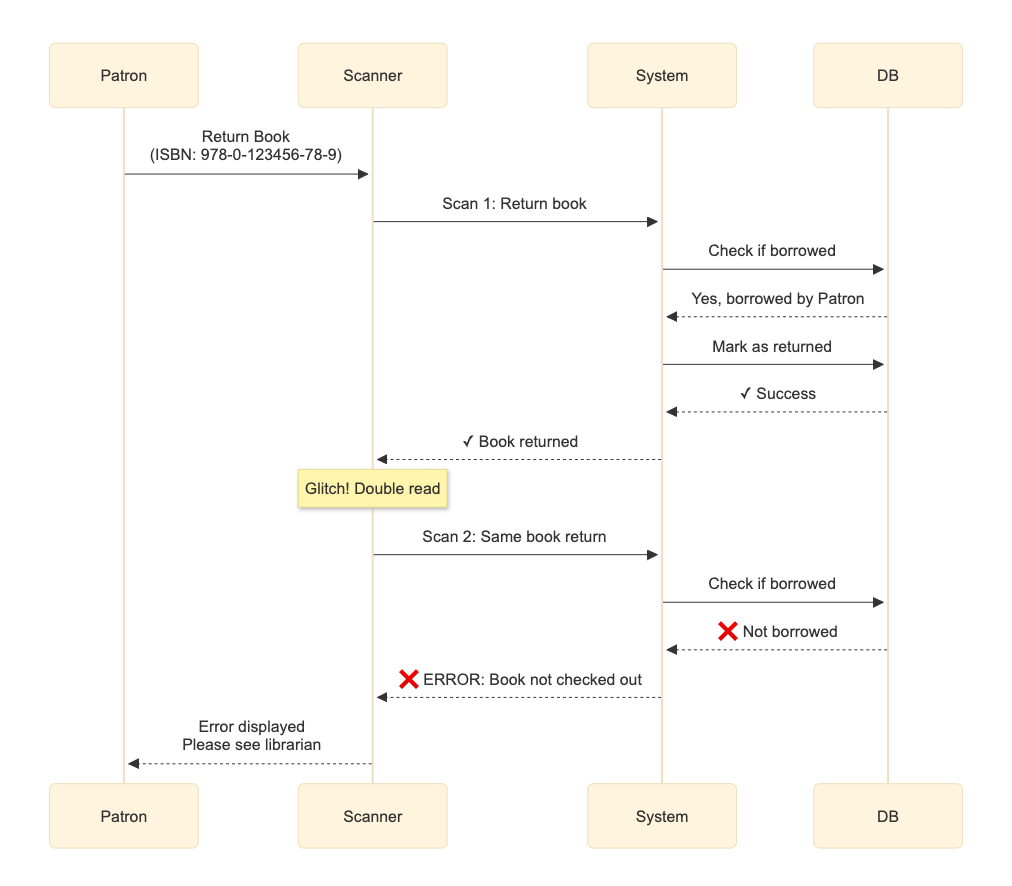
What Happens:
First scan succeeds—book marked as returned
Scanner glitches and reads barcode again
System tries to return the same book twice
Second attempt fails: "Book not checked out"
Patron confused, librarian called, manual intervention required
The Impact: Poor user experience, manual overhead, system appears broken
With Idempotency (The Resilient Approach)
Each return transaction gets a unique identifier combining:
Book ISBN
Borrower card number
Timestamp (rounded to nearest minute)
Example ID: RETURN-978-0-123456-78-9-PATRON-42-2026-02-08-14-32
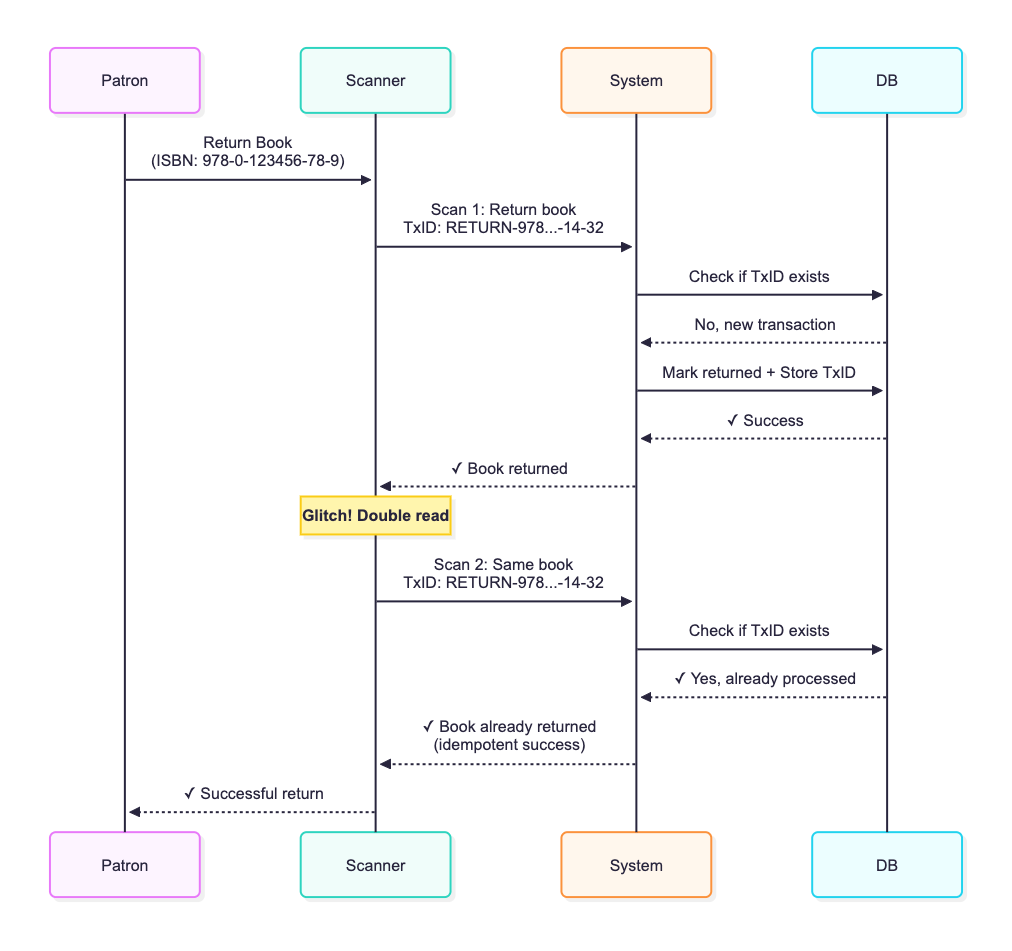
What Happens Now:
First scan succeeds—book marked as returned, transaction ID stored
Scanner glitches and reads barcode again
System recognizes duplicate transaction ID
Returns success without processing again
Patron sees successful confirmation, no manual intervention needed
System Design Parallels:
| Library Concept | Distributed System Equivalent |
|---|---|
| Unique transaction ID | Idempotency key (Rule #11) |
| Duplicate scanner reads | Network retry after timeout |
| Checking if TxID exists | Deduplication logic |
| Ignoring duplicate operations | Idempotent request handling |
| Glitchy scanner | Unreliable network (Rule #4) |
Thumb Rules Applied:
✅ Rule #4 (Design for Failure): Assume scanners will glitch, networks will retry
✅ Rule #11 (Smart Retries): Treat duplicate operations as retries with idempotency keys
Scenario 3: The Town Hall Vote (Quorum Consensus & Split-Brain Prevention)
The Problem: A town council has 5 members who need to vote on new legislation. Due to scheduling conflicts and communication issues, members sometimes meet in separate groups.
Without Quorum (The Chaos Scenario)
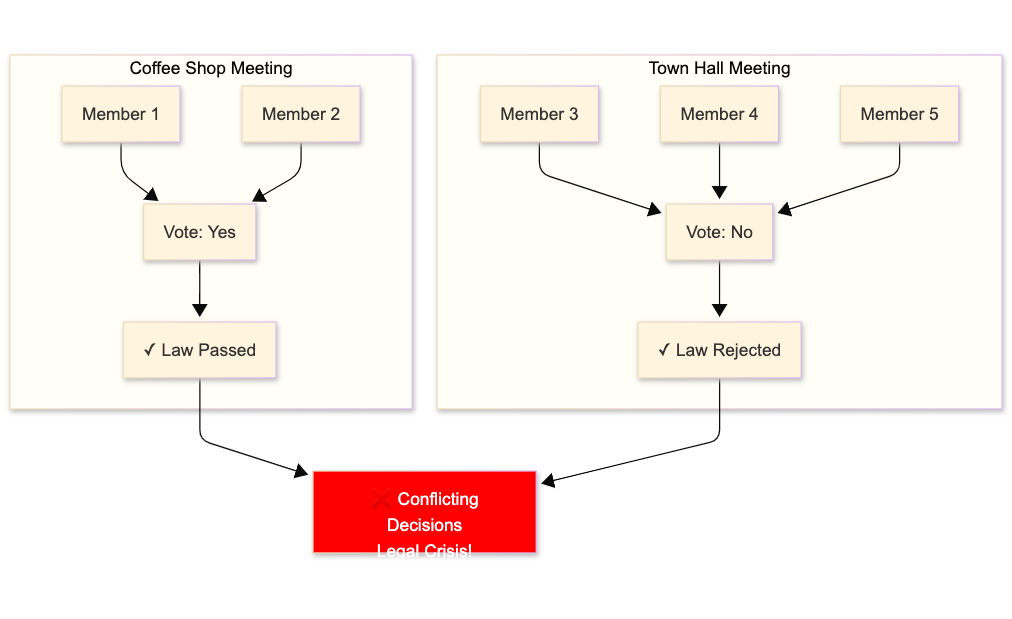
What Happens:
Group 1 (2 members): Meets informally at coffee shop, votes to pass the law
Group 2 (3 members): Meets at town hall, votes to reject the law
Result: Two conflicting official decisions, constitutional crisis, lawsuits
The Core Problem: This is called split-brain—when a distributed system partitions into multiple groups that each believe they're in charge and make conflicting decisions.
With Majority Quorum (The Safe Approach)
Require that any decision needs agreement from at least ⌈(N+1)/2⌉ members. For N=5, that's ⌈(5+1)/2⌉ = 3 members minimum.
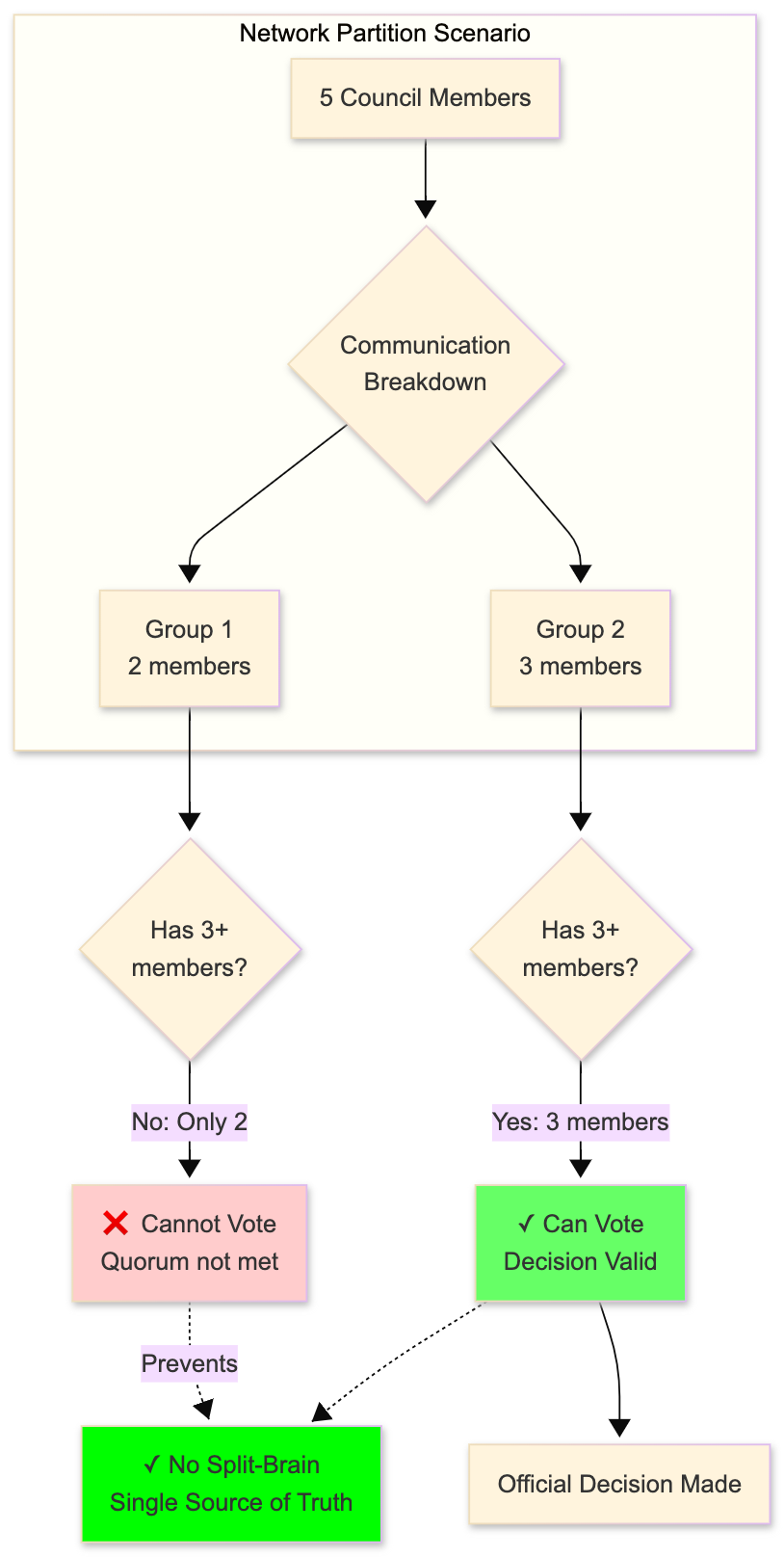
What Happens Now:
Group 1 (2 members): Tries to vote but cannot meet quorum (need 3, have 2)
Group 2 (3 members): Meets quorum, can make valid decision
Result: Only one group can make binding decisions, preventing conflicts
The Math: Even if the council splits into two groups, at most one group can have 3+ members:
Split 2-3: Group of 3 can vote, group of 2 cannot
Split 1-4: Group of 4 can vote, group of 1 cannot
Split 0-5: All 5 together can vote (ideal case)
System Design Parallels:
| Town Hall Concept | Distributed System Equivalent |
|---|---|
| Council members | Distributed nodes in cluster |
| Coffee shop vs town hall | Network partition |
| Majority requirement (3/5) | Quorum consensus (Paxos, Raft) |
| Preventing dual decisions | Avoiding split-brain |
| Valid decision | Leader election, distributed lock |
Thumb Rules Applied:
✅ Rule #4 (Design for Failure): Assume network partitions will isolate nodes
✅ Quorum Pattern: Require ⌈(N+1)/2⌉ agreement for critical decisions
Real-World Applications:
Leader election in distributed databases (Cassandra, MongoDB)
Distributed locks (etcd, ZooKeeper, Consul)
Cluster coordination (Kubernetes control plane)
Consensus protocols (Paxos, Raft, Viewstamped Replication)
Conclusion: From Principles to Practice
Your Action Plan
Step 1:
[ ] Pick one existing system
[ ] Write a one-page budget document (Phase 1)
[ ] Identify one failure mode and add redundancy
Step 2:
[ ] Apply the full 4-phase workflow to a new feature
[ ] Run one failure drill
[ ] Add instrumentation for the Four Golden Signals
Step 3:
[ ] Complete a load test with realistic patterns
[ ] Write runbooks for top 3 failure scenarios
[ ] Measure: Did your SLOs improve?
Remember
The best systems aren't those with the most elegant diagrams, but those that:
Work reliably in production
Evolve gracefully with requirements
Provide real value to users
Survive failures without drama
About This Series: This is part of a practical guide to system design. The first article established twelve foundational thumb rules. This follow-up demonstrates their practical application through workflows and real-world scenarios.
Last Updated: February 2026

